
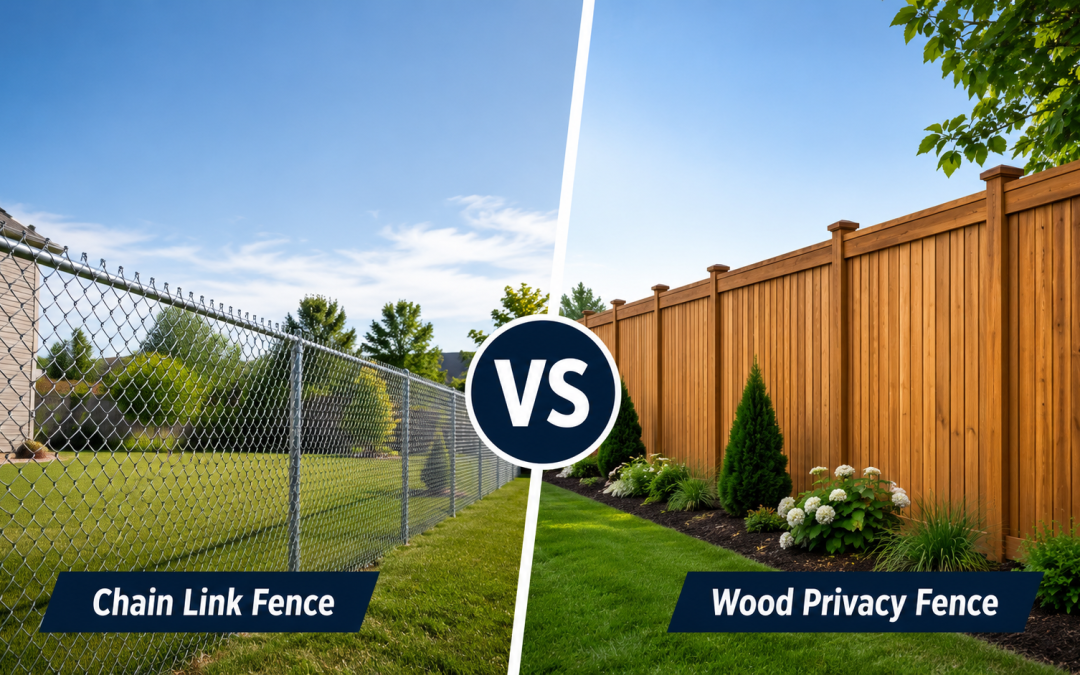
Choosing the right fence for your property is about more than just picking a style you like. It affects your home’s privacy, security, curb appeal, and long-term maintenance costs. Two of the most popular options homeowners compare are the chain link fence and the wood privacy fence. Both have loyal fans, but they serve very different purposes.
In this guide, we’ll break down the pros, cons, and costs of each so you can make a confident decision for your property.
Chain Link Fence: Overview
A chain link fence is a woven steel wire fence known for its affordability, durability, and low upkeep. It’s commonly used for backyards, dog runs, commercial properties, and areas where security matters more than full visual privacy.
Pros of Chain Link Fencing
- Budget-friendly: One of the most affordable fencing solutions on the market
- Low maintenance: No painting, staining, or sealing required
- Durable: Galvanized or vinyl-coated steel resists rust and holds up for 15-20+ years
- Fast installation: Simple design means quicker install times
- Good visibility: Ideal for keeping an eye on pets, kids, or property lines
- Great for security: A popular choice for security fencing on commercial and industrial sites
Cons of Chain Link Fencing
- Minimal privacy: The open weave offers little screening unless paired with slats or landscaping
- Less curb appeal: Doesn’t offer the warm, finished look many homeowners want
- Noise transfer: Sound travels more easily through an open fence
- Can look industrial: Better suited to utility, security, or budget-focused projects than upscale residential aesthetics
Chain Link Fence Cost
Chain link fencing is typically one of the cheapest fencing options, generally running lower per linear foot than wood or ornamental metal, especially for standard heights. Costs rise with taller fences, vinyl coating, or added privacy slats.
Wood Privacy Fence: Overview
A wood privacy fence is the classic choice for homeowners who want a solid, attractive barrier that blocks sightlines completely. Built from cedar, pine, or pressure-treated wood, it remains one of the most requested styles for backyards across Houston.
Pros of Wood Privacy Fencing
- Full privacy: Solid panel construction blocks visibility completely
- Classic curb appeal: Adds natural warmth and value to a property
- Customizable: Available in multiple styles, heights, and stain colors
- Sound dampening: Solid wood panels reduce outside noise better than open fencing
- Increases property value: A well-built wood privacy fence is a strong selling point for buyers
Cons of Wood Privacy Fencing
- Higher maintenance: Requires periodic staining, sealing, and repairs
- Weather exposure: Humidity, rain, and sun can cause warping or rotting over time if not maintained
- Shorter lifespan than steel: Typically lasts 15-20 years with proper care, less without it
- Higher upfront cost: More expensive than chain link for the same length of fencing
Wood Fence Cost
Wood fence cost depends heavily on the type of wood, fence height, and property size. Cedar and higher-grade wood cost more than pressure-treated pine, but offer better resistance to rot and insects. Labor and finishing (staining/sealing) also add to the total project cost.
Chain Link vs. Wood: Side-by-Side Comparison
| Factor | Chain Link Fence | Wood Privacy Fence |
| Privacy | Low (unless slats added) | High |
| Upfront Cost | Lower | Higher |
| Maintenance | Minimal | Regular staining/sealing |
| Lifespan | 15-20+ years | 15-20 years (with maintenance) |
| Curb Appeal | Basic/utilitarian | High, classic look |
| Best For | Security, budget, pet containment | Backyard privacy, resale value |
Long-Term Cost of Ownership: Beyond the Initial Price
When comparing a chain link fence to a wood privacy fence, it’s easy to focus only on the upfront installation price, but the real cost story unfolds over time. A chain link fence typically has a lower total cost of ownership because it doesn’t require repainting, staining, or sealing, and galvanized or vinyl-coated steel resists corrosion for well over a decade with almost no upkeep. A wood privacy fence, on the other hand, comes with recurring costs: staining every 2-3 years, occasional board replacement due to warping or insect damage, and periodic hardware tightening. Homeowners should budget for this ongoing maintenance rather than assuming a “set it and forget it” outcome once the fence is installed. Factoring in these long-term expenses often changes the math, especially for larger properties where even small per-linear-foot maintenance costs add up quickly across a full perimeter fence.
Climate Considerations for Houston Homeowners
Houston’s climate plays a bigger role in this decision than many homeowners realize. The region’s high humidity, frequent rainfall, and intense summer heat can accelerate wear on both fence types if the wrong materials or finishes are chosen. A wood privacy fence built with cedar or properly pressure-treated lumber holds up far better in this environment than lower-grade wood, which is prone to swelling, warping, and rot when moisture is trapped against untreated boards. A chain link fence, meanwhile, should ideally use galvanized or vinyl-coated steel rather than bare steel, since humidity and salt air (common closer to the Gulf) can speed up rust formation on unprotected metal. Choosing the right grade of material upfront, rather than the cheapest option available, is one of the most effective ways to extend the lifespan of either fence type in a Houston climate.
Resale Value and Buyer Perception
Fencing choices can also influence how potential buyers perceive a property if you ever decide to sell. A well-maintained wood privacy fence is generally seen as a desirable feature that signals a finished, move-in-ready backyard, particularly for buyers with children or pets who prioritize enclosed outdoor space. A chain link fence, while practical, is more often associated with functional or budget-oriented properties and may not carry the same aesthetic weight during a home sale or appraisal. That said, chain link remains an excellent choice for rental properties, commercial sites, or homeowners who plan to stay long-term and prioritize durability and cost savings over resale-driven curb appeal. Understanding your timeline and goals for the property can help clarify which fence type delivers the better return on investment.
Which Fence Is Right for You?
- Choose a chain link fence if your priority is affordability, durability, and low-maintenance security — especially for commercial properties, large lots, or dog runs.
- Choose a wood privacy fence if you want maximum privacy, a polished residential look, and are willing to invest in occasional upkeep for a fence that boosts your home’s value and appearance.
Many Houston homeowners also combine both: chain link for side or utility areas, and a wood privacy fence around the backyard living space.
Get Expert Fence Installation in Houston
At Ayms Corporation, we install and repair both wooden fences and chain link fences for homeowners and businesses throughout the Greater Houston area. Our team can help you compare materials, styles, and pricing so you get a fence built to last. Contact us today for a free estimate.
Frequently Asked Questions
- Is a chain link fence cheaper than a wood fence?
Yes, chain link fencing is generally more affordable than wood, both in materials and installation, making it a popular choice for budget-conscious projects. - Which fence lasts longer, chain link or wood?
Chain link fencing typically lasts longer with less maintenance, since it doesn’t warp, rot, or require staining like wood does. Wood can last just as long with proper care. - Can I add privacy to a chain link fence?
Yes, privacy slats, mesh screening, or fast-growing landscaping can be added to a chain link fence to increase privacy without switching materials entirely. - How often does a wood privacy fence need to be maintained?
Most wood fences should be cleaned and re-stained or sealed every 2-3 years to protect against moisture, humidity, and sun damage. - Does a wood fence increase home value more than chain link?
Generally, yes. A well-maintained wood privacy fence tends to boost curb appeal and resale value more than chain link, which is viewed as more utilitarian. - Is chain link or wood fencing better for pets?
Both work well. Chain link offers visibility to monitor pets, while a wood privacy fence prevents pets from seeing outside distractions, which can reduce barking. - Which fence requires a permit in Houston?
Permit requirements vary by city, HOA, and fence height. It’s best to check local regulations or ask your fencing contractor before installation. - Can chain link and wood fencing be combined on one property?
Yes, it’s common to use chain link for side yards or utility areas and a wood privacy fence for the main backyard or front-facing areas. - How long does installation take for each fence type?
Chain link installation is typically faster due to its simpler design, while wood privacy fences take a bit longer because of panel construction and finishing work. - Which fence is better for noise reduction?
A solid wood privacy fence blocks more outside noise than an open chain link fence, making it a better option for busy streets or noisy neighborhoods.