Choosing the right fence depends on what you need the fence to accomplish. A residential privacy fence may be ideal for creating a private backyard, while a decorative metal fence can improve the appearance of a property. However, properties that need stronger perimeter control, livestock containment or an additional security deterrent may require a different solution.
This is where barbed wire fencing can be a practical choice.
A barbed wire fence is designed to create a physical boundary while making unauthorized access more difficult. It is commonly used for agricultural land, ranches, livestock areas, equipment yards, warehouses, storage properties and industrial facilities. AYMS Fence provides barbed wire fencing installation and repair throughout Houston, Katy and surrounding areas, with solutions designed for agricultural, commercial and industrial applications.
But when should you actually choose a barbed wire fence instead of another fencing option?
The answer depends on your property, security requirements, type of use, location and applicable local requirements. In this guide, we explain when barbed wire fencing in Houston may be the right solution and what you should consider before installation.
What Is Barbed Wire Fencing?
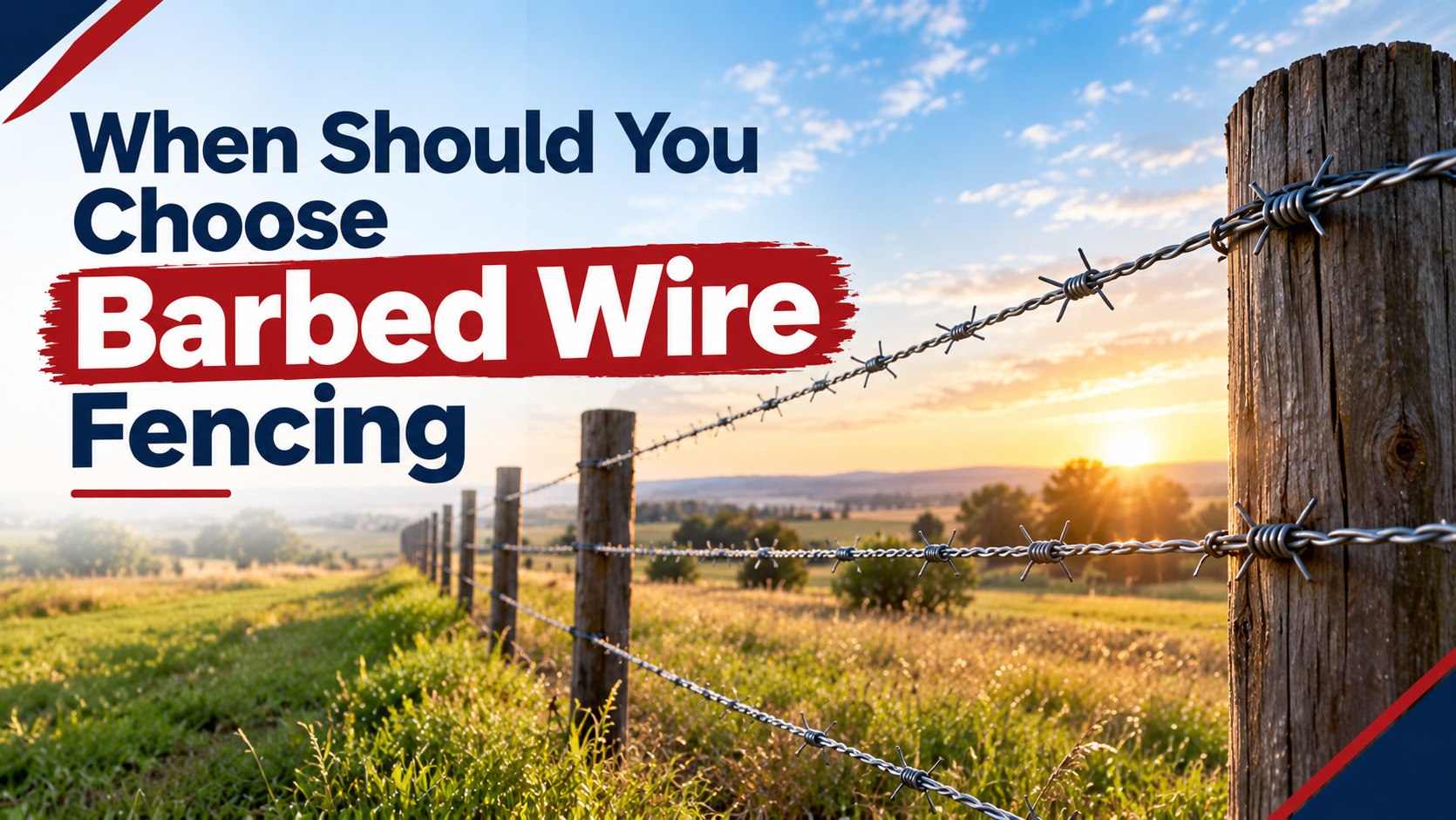
Barbed wire fencing consists of strands of metal wire with sharp barbs positioned along the wire at intervals. When properly installed, the barbs act as a deterrent and make climbing over or passing through the fence more difficult.
Unlike a traditional privacy fence, the primary purpose of barbed wire fencing is not to completely block visibility. Instead, it is generally used to establish a perimeter, contain animals or provide an additional security layer.
For properties with large boundaries, this can make barbed wire an economical and practical fencing solution. It can also be combined with other fencing systems when a property requires both a physical barrier and an additional security layer. AYMS Fence, for example, provides combination fencing using barbed wire alongside field fence, welded wire or pipe fencing for certain agricultural and mixed-use properties.
When Should You Choose Barbed Wire Fencing?
When Livestock Containment Is a Priority
One of the most established applications for barbed wire fencing is livestock containment. Ranches, farms and agricultural properties often need fencing that can define property boundaries while helping keep livestock within designated areas.
If you own cattle or manage agricultural land, the fence needs to withstand regular outdoor exposure and the pressure that animals can place on a fence line. A properly planned livestock fencing Houston solution can help create clear boundaries across larger properties.
Barbed wire can be particularly useful where the objective is to establish long stretches of fencing across open land. Instead of installing a solid privacy fence across several acres, property owners can use an agricultural fencing system designed around the specific requirements of the land and livestock.
The appropriate fence design should depend on the animals being contained, terrain, property layout and applicable agricultural requirements. Professional planning is particularly important because an agricultural fence needs to balance containment, durability and safe operation.
When You Need to Secure Large Acreage
Large properties can present a very different fencing challenge from a typical residential backyard.
If you own several acres of land, installing a solid privacy fence around the entire property can require a substantial amount of material and labour. A barbed wire fence can provide a more open perimeter solution for agricultural and rural properties where complete visual privacy is not the primary objective.
For large-acreage property owners, the focus may instead be on clearly defining the property boundary, controlling access and discouraging unauthorized entry.
This makes farm fencing Houston and rural perimeter fencing an important application for barbed wire systems.
Before installation, property owners should make sure the fence line is properly established and that any applicable local requirements are understood.
When Perimeter Security Is Your Main Concern
A fence does not need to completely prevent access to be useful. Sometimes its purpose is to create an additional deterrent around a property.
For warehouses, equipment yards, industrial properties and storage facilities, security fencing solutions can help establish a more controlled perimeter.
A barbed wire fence can make climbing or crossing a fence more difficult, particularly when it is installed as part of a properly designed security perimeter. For some properties, barbed wire may also be added to an existing fence rather than replacing the entire system.
This can be useful when an existing chain link or other perimeter fence is structurally sound but the property owner wants an additional security layer. AYMS Fence specifically offers perimeter upgrades where barbed wire can be added to existing fencing systems rather than requiring a complete replacement.
When You Own an Equipment or Storage Yard
Equipment yards can contain valuable vehicles, machinery, construction equipment and materials. Leaving these assets behind a basic or easily accessible perimeter may not provide the level of deterrence that the property requires.
A properly designed commercial barbed wire fencing system can help establish a stronger boundary around equipment storage areas and commercial yards.
For businesses, the objective is often not simply to create a fence but to create a perimeter that supports the property’s overall security strategy. The fence may be combined with controlled gates, lighting, cameras and other security measures depending on the site.
Barbed wire should therefore be considered as one component of a wider property-security plan rather than as a standalone solution for every security concern.
When Is Barbed Wire Useful for Industrial Properties?
Industrial facilities often have larger perimeters and different security requirements than residential properties.
A manufacturing facility, warehouse, distribution centre or industrial yard may need to control access around loading areas, storage zones and outdoor equipment.
Industrial fencing projects can use barbed wire as part of a perimeter system where the property requires a stronger deterrent. AYMS Fence identifies warehouses, distribution centres, equipment yards, storage lots and industrial facilities among the applications for its barbed fencing services.
The appropriate design depends on the facility, existing fencing, site layout and security requirements. A professional assessment can help determine whether a complete barbed wire fence or an upgrade to an existing perimeter makes more sense.
When Should You Add Barbed Wire to an Existing Fence?
You do not always need to replace an existing fence to improve perimeter security.
If your current fence posts and structure are still in good condition, it may be possible to add barbed wire as an additional layer.
For example, a commercial property may already have a chain link fence around its perimeter. If the fence remains structurally sound but the property owner wants to make climbing more difficult, a properly designed barbed wire extension may be considered.
This approach can be more practical than completely removing and replacing an otherwise usable fence.
AYMS Fence offers barbed fence installation as well as repair, reinforcement and perimeter upgrades, allowing property owners to address specific weaknesses in an existing fence system.
When Is Barbed Wire Not the Right Choice?
Although barbed wire can be highly practical for agricultural and commercial applications, it is not appropriate for every property.
For a typical residential backyard where the primary goal is privacy, a wood privacy fence may be more suitable. For decorative front-yard applications, aluminum or ornamental iron fencing may provide the appearance a homeowner wants.
Barbed wire can also present safety considerations because of its sharp barbs. This is particularly important around areas where children, pets, pedestrians or members of the public may come into frequent contact with the fence.
Local rules, property restrictions and HOA requirements may also affect whether barbed wire can be installed at a particular location. AYMS Fence notes that requirements can vary by property type and local ordinance and recommends confirming what applies to the specific property before installation.
For this reason, property owners should not select a barbed wire fence simply because it is inexpensive or provides a strong deterrent. The fence needs to be appropriate for the property’s purpose and location.
How Much Does Barbed Wire Fencing Cost?
The cost of barbed wire fence installation depends on several factors, so there is no single price that applies to every property.
The total cost can depend on the length of the fence, number of strands, type of wire, posts, terrain, installation requirements and whether the barbed wire is being added to an existing fence.
Current cost sources show a wide range because projects vary significantly. For example, Angi reports a national average of about $3,814 for barbed wire fence installation, with most projects between $1,612 and $6,154, while Houston-specific estimates vary according to whether the project involves a simple wire fence or a more substantial perimeter system.
For Houston property owners, it is therefore better to obtain a project-specific estimate rather than relying on a generic online price.
A professional barbed wire fence Houston TX contractor can assess the property, measure the fence line, evaluate the terrain and determine what materials and installation method are appropriate.
What Affects Barbed Wire Fence Installation Cost?
The length of the fence is one of the most important factors. A property requiring several thousand linear feet of fencing will naturally require more materials and installation time than a small perimeter.
The number of strands can also affect the overall cost. A project designed for livestock containment may have different requirements from a commercial security perimeter.
The condition of the existing fence is another consideration. If the posts and fence structure are suitable for an upgrade, adding barbed wire may be more economical than installing a completely new perimeter. If the existing posts are damaged or incorrectly spaced, additional reinforcement or replacement may be necessary.
Terrain can also affect installation. Uneven ground, difficult access, existing concrete, drainage areas and challenging soil conditions can increase installation complexity.
For this reason, a professional site assessment is usually the best way to determine the actual barbed wire fence cost for a property.
How Long Does a Barbed Wire Fence Last?
The lifespan of a barbed wire fence depends on the quality of the wire, protective coating, posts, installation and local weather conditions.
Galvanized wire is commonly used because the zinc coating helps protect the steel from corrosion. Regular inspection can also help identify damaged or sagging sections before they become larger problems.
In Houston, exposure to humidity, rain and storms makes maintenance particularly important. A fence that is inspected and repaired when problems first appear can generally provide better long-term performance than one that is left unattended.
The posts and supporting structure are equally important. Even durable wire will not perform properly if the posts become unstable or the fence loses appropriate tension.
Barbed Wire Fencing for Houston’s Climate
Houston’s weather should be considered when selecting an outdoor fencing system.
The region experiences high humidity, significant rainfall and severe weather events. These conditions can contribute to corrosion and deterioration if fencing materials are not properly selected and maintained.
For barbed wire fencing properties, material quality, installation technique and regular inspections can therefore make an important difference.
After major storms, property owners should inspect their fence line for broken wire, damaged posts, fallen trees or sections that have lost tension. Addressing these issues early can help prevent a small repair from becoming a much larger replacement project.
Barbed Wire vs Other Fencing Options
The right fence depends on the purpose of the property.
For agricultural land where the primary objective is livestock containment and boundary definition, barbed wire can be a practical solution across large areas.
For residential properties where privacy is the main priority, a wood privacy fence may be more appropriate because it creates a solid visual barrier.
For commercial properties that require an open but durable perimeter, chain link fencing combined with barbed wire may provide a practical security configuration.
For properties where appearance is particularly important, ornamental aluminum or wrought iron may be preferable.
This is why choosing a fence should begin with the property’s requirements rather than simply selecting a material based on price.
Should You Choose Barbed Wire or Razor Wire?
Barbed wire and razor wire are not the same product.
Barbed wire uses pointed barbs attached to strands of wire, while razor wire uses sharper blade-like elements and is generally associated with higher-security applications.
For many agricultural and commercial fencing applications, traditional barbed wire may be sufficient. However, properties with specialised security requirements may need a different perimeter system.
The appropriate option should be determined by the property’s security requirements, applicable regulations and the recommendations of a qualified fencing professional.
Why Professional Barbed Wire Fence Installation Matters
Installing barbed wire requires more than simply attaching wire to posts.
The fence needs to be properly measured, aligned and tensioned. Posts need to provide adequate structural support, while gates and access points need to work with the overall perimeter design.
Professional installation can also help reduce problems such as sagging wire, unstable posts and poorly planned fence lines.
AYMS Fence provides new installations, repairs, reinforcement and perimeter upgrades for barbed fencing across Houston, Katy and surrounding areas. The company states that it has more than 15 years of fencing experience and provides licensed and insured services.
When Should You Choose Barbed Wire Fencing?
Ultimately, barbed wire fencing makes the most sense when you need a practical perimeter solution for agricultural land, livestock, large-acreage properties, commercial facilities, equipment yards, warehouses or industrial sites.
It can be particularly useful when you need to define a large property boundary, contain livestock or create an additional security deterrent without installing a completely solid fence.
However, barbed wire is not automatically the right choice for every property. Residential safety, local regulations, HOA requirements, property use and the presence of children or pets should all be considered before installation.
The best approach is to evaluate the purpose of the fence first and then select a system that provides the appropriate combination of security, containment, durability and cost.
For property owners in Houston and Katy, AYMS Fence provides barbed wire fence installation, repair and perimeter upgrades for agricultural, commercial and industrial properties. A professional assessment can help determine whether barbed wire is suitable for your property and whether a new installation or an upgrade to your existing fence makes more sense.
Frequently Asked Questions About Barbed Wire Fencing
- When should you choose barbed wire fencing?
You should consider barbed wire fencing when you need livestock containment, large-property boundary definition or an additional security deterrent around agricultural, commercial or industrial property. The suitability of barbed wire depends on the property type and applicable local requirements.
- Is barbed wire fencing good for farms and ranches?
Yes. Farm fencing Houston and ranch fencing are common applications for barbed wire because it can cover large areas while helping establish property boundaries and contain livestock.
- Is barbed wire suitable for commercial properties?
Barbed wire can be suitable for warehouses, equipment yards, storage lots and industrial properties where perimeter security is an important consideration. AYMS Fence specifically provides barbed fencing for commercial and industrial applications.
- Can barbed wire be added to an existing fence?
Yes. If the existing fence and posts are structurally suitable, barbed wire can sometimes be added as a perimeter upgrade. This can provide an additional security layer without requiring complete fence replacement.
- How much does a barbed wire fence cost?
The cost varies based on fence length, wire type, number of strands, posts, terrain and installation requirements. Current published estimates vary considerably, so a site-specific quote is more useful than relying on a single average price.
- Is barbed wire fencing legal in Houston?
Whether barbed wire is permitted depends on the property, location and applicable local requirements. AYMS Fence advises property owners to confirm the rules that apply to their specific property before installation.
- Is barbed wire good for livestock?
Barbed wire is commonly used for livestock containment and agricultural fencing. However, the appropriate fence configuration depends on the type of livestock, property layout and applicable agricultural requirements.
- How long does a barbed wire fence last?
The lifespan depends on the quality and coating of the wire, supporting posts, installation, weather exposure and maintenance. Galvanized wire and regular inspections can help protect the fence from premature deterioration.
- Can a barbed wire fence be repaired?
Yes. Damaged wire, sagging sections and damaged posts can often be repaired or reinforced without replacing the entire fence. AYMS Fence provides repair and reinforcement services for existing barbed-wire fencing.
- Who should install a barbed wire fence?
A professional barbed wire fence contractor should handle installation because proper alignment, post support and wire tension are important for the fence to perform correctly. A professional contractor can also help assess the property and identify applicable requirements before installation.
Related posts:
Chain Link vs. Wood Privacy Fence: Pros, Cons, and Costs

Why AYMS Fence Is a Trusted Name for Quality Fence Solutions

How to Choose a Fence Contractor in Houston: 7 Questions to Ask